
OSVI Healthcare Blog
What is a PFT Test?
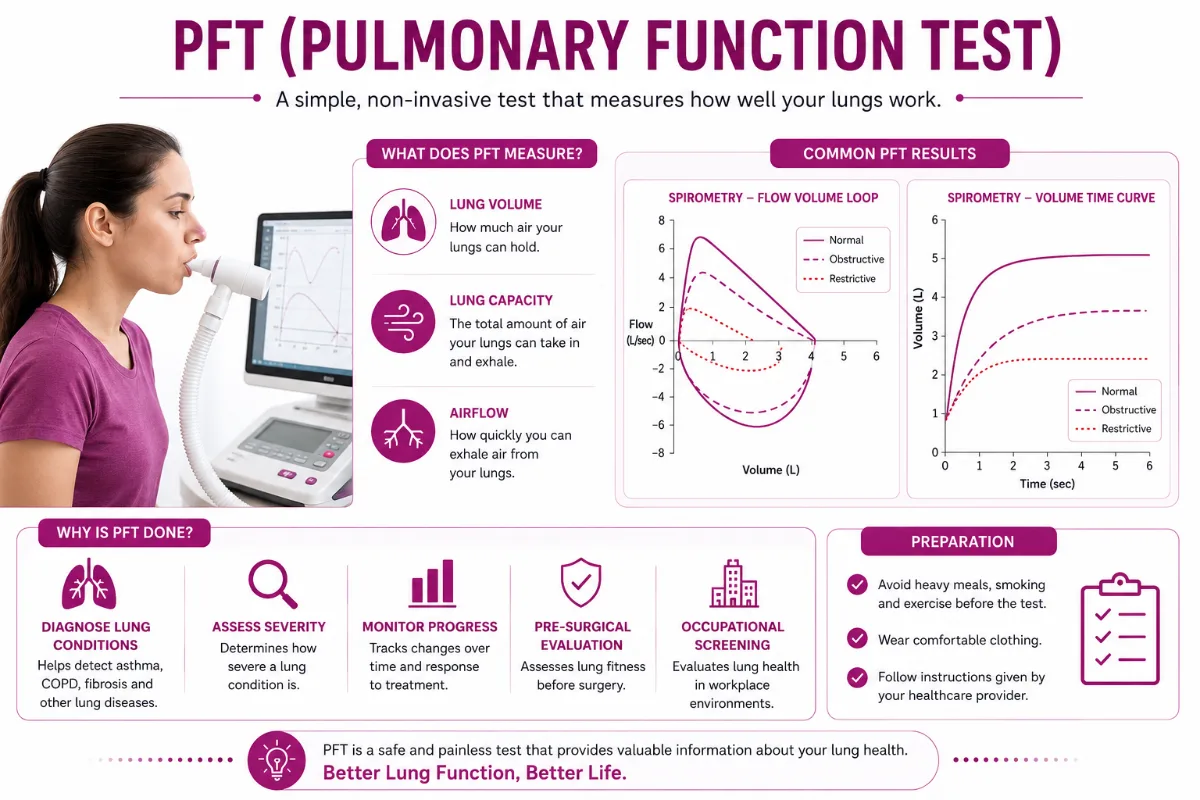
A pulmonary function test (PFT), or lung function test, is a breathing test that shows how well the lungs are working. There are no needles and no pain: the patient breathes into a mouthpiece while a technician guides them. The most common PFT is spirometry. This guide explains what the test measures, how to prepare, and what to expect.
What Does a PFT Measure?
Spirometry measures how much air the patient can breathe out, and how fast. The two main numbers on the report are:
- FVC (forced vital capacity): the total air the patient can blow out, hard and fully, after the deepest possible breath.
- FEV1 (forced expiratory volume in 1 second): how much of that air comes out in the first second.
- FEV1/FVC ratio: the doctor compares the two numbers. In healthy lungs, most of the air comes out in the first second. Narrowed airways slow the air down.
Sometimes the doctor asks for more detailed tests, usually done in a hospital lung function lab:
- Lung volume test: how much air the lungs can hold, including the air left inside after breathing out fully.
- Diffusion test (DLCO): how well oxygen passes from the lungs into the blood. The patient breathes in a very small, safe amount of a test gas and holds the breath for about 10 seconds.
Why Do Doctors Ask for a PFT?
- To find the cause of breathlessness, wheezing, chest tightness or a long-lasting cough
- To help diagnose asthma, COPD or lung fibrosis (interstitial lung disease)
- To check how well a treatment or inhaler is working, and to follow a lung condition over time
- To check the lungs before an operation
- To look for lung effects of smoking, dust, chemicals or some medicines
The test may be repeated 15 to 20 minutes after a reliever inhaler. How much breathing improves can help the doctor tell asthma and COPD apart.
How to Prepare for the Test
- Inhalers: ask the doctor whether to take them before the test. Some are paused for several hours or longer, but stop a medicine only if the doctor says so. Keep inhalers and spacer ready.
- No smoking for 24 hours before.
- No heavy meal for 2 hours, and no alcohol for 4 hours, before.
- No heavy exercise for 30 minutes before. Avoid tea and coffee if the doctor advises.
- Wear loose clothes that do not press on the chest or belly. Keep dentures in.
What Happens During the Test
- The technician notes the patient’s age, height, weight and sex.
- The patient sits, and a soft clip is placed on the nose.
- The patient takes the deepest breath possible, seals the lips around the mouthpiece and blows out as hard and as long as they can.
- This is repeated at least three times, with short rests, so that the results are reliable.
- If the doctor asked for it, the patient uses the inhaler, waits, and does the test again.
Spirometry usually takes about 15 to 30 minutes. Some people feel dizzy, light-headed or tired, or cough afterwards; this usually passes in a few minutes. Tell the technician at once if the patient feels faint or has chest pain.
Who Should Wait or Avoid the Test
Blowing hard puts pressure on the chest, head and eyes. Tell the doctor before the test if the patient has:
- A recent heart attack or stroke, other heart problems, or uncontrolled blood pressure
- Recent surgery on the eye, chest, belly, brain, ear or sinuses
- A chest infection, fever, coughing up blood, or suspected tuberculosis
- A collapsed lung (pneumothorax) or a known brain aneurysm
- Late pregnancy, or a history of fainting while coughing or blowing hard
The doctor will decide whether the test is safe now, or how long to wait.
Understanding the Results
The patient’s numbers are compared with the values expected for a healthy person of the same age, height and sex. You cannot pass or fail a PFT. Broadly, the results can show:
- An obstructive pattern: the airways are narrowed, so air comes out slowly, as in asthma or COPD.
- A restrictive pattern: the lungs cannot fill fully, as in lung fibrosis and other interstitial lung diseases.
A PFT does not name a disease by itself, and a low number does not always mean lung disease. The doctor reads it with the symptoms and other tests, such as a chest X-ray or ABG. Never change a medicine based on the report alone.
When Breathlessness Cannot Wait
A PFT is a planned test. See a doctor soon if breathlessness gets worse with normal activities or when lying down, comes with swollen ankles, or a cough has lasted 3 weeks or more.
Call 112 straight away if the patient is gasping or cannot get words out, has a tight or heavy chest, pain spreading to the arms, back, neck or jaw, lips or skin turning blue or grey, or sudden confusion. See what to do in a medical emergency at home.
PFT at Home with OSVI Healthcare
For elderly patients, or anyone who finds travel hard, a trip to a hospital lab can be tiring. PFT is one of the diagnostic services OSVI Healthcare offers at home, along with X-ray, ECG, ABG, Holter monitoring, ultrasound, echo and sleep studies. This is how it works:
- Share the doctor’s advice. Tell us which test the doctor has asked for.
- Test at home. The lung function test is done at home.
- Doctor-reviewed report. The report is reviewed by OSVI doctors, so you can discuss it with your treating doctor.
No doctor yet? Book a doctor visit at home or an online consultation. Blood tests can be added through home sample collection.
Frequently Asked Questions
How long does a PFT take?
Spirometry alone takes about 15 minutes, and about 30 minutes when it is repeated after an inhaler. Lung volume and diffusion tests in a lab take extra time.
Can children have a PFT?
Spirometry is usually suitable for children over five. Younger children may find it hard to follow the breathing steps, so the doctor may choose another test.
Should the patient take their inhaler on the morning of the test?
Ask the doctor who ordered the test. Never stop a medicine on your own.
Can a PFT be done at home?
Yes. PFT is one of our diagnostic services at home. Some detailed lung tests are usually done in a hospital lab, so check with the doctor which test is needed and tell our team.
Book a PFT Test with OSVI Healthcare
Share the doctor’s advice with us, and our team will arrange the lung function test at home.
Book a PFT Test at HomeThis article is provided for general information and does not constitute medical advice, diagnosis or treatment. Every patient’s situation is different, so please consult a qualified doctor for guidance specific to you. In a medical emergency, call 112.